Thursday, 8 November 2018

Somewhere under a Rainbow


There are few settings that put me quite as at peace as the River Wye.  Beautiful, tranquil and some of the best barbel water anywhere in the country, the perfect venue for some much needed downtime.  My partner for the day would be Nick Fisher and a booking via the WUF would allow us to have the beat to ourselves undisturbed.  Being a Friday in late October, we were hopeful of avoiding a circus of Kayaks and blissfully we weren’t to see a single boat all day.

Similar to a child at Christmas, I never sleep particularly well the night before fishing.  I quietly manage to get over-excited, my mind busy with tactics, approaches, hopes and dreams.  Rising a little after six, I for once managed to leave on time, heading out into the cold rainy darkness only to realize ten minutes down the road I had left my bag of warm and wet weather clothing by the door.  Having returned and restarted the journey, it was a little after dawn when I arrived in the Wye Valley.

Greeting Nick in the farmyard, we decanted my gear into his 4x4 and made our way through the series of farm gates and electric fences down to the river. It was not quite the dawn start I had hoped for, but with still a hint of twilight remaining it wasn’t exactly a late start and there was still plenty of morning to go at.

Dawn on the Wye - worth an early start

Directly downslope of the field gate is the swim most fished on this beat.  It has spectacular views upstream for almost a mile of river and is well worth an early arrival to watch wisps of mist rising up from the crisp turbulent water.  Downstream the view is equally picturesque, with the river framed by a salmon croy to the left-hand bank, a mature tree to the right and the hillside forestry of the Wye Valley beyond.  The swim is as compelling as the scenery, with a concrete walkway at the near bank constraining the flow, causing the river to narrow and deepen to a couple of metres in depth.  The flow is fast with banks of streamer weed directly upstream, a gravel bottom and a deep pool directly downstream.  A little time spent finding the snag-free gravel patches is well invested but with a little too much flow on, this would not be our swim for today.  Whilst it’s always a banker for a barbel or two, my judgement was that the barbel would likely be holed up in greater numbers elsewhere.

Introducing a few free offerings to build the fish’s confidence with a view to returning later if our first-choice swim didn’t produce, we made our way upstream to the deep slower water towards the top of the beat.  We set up at the top of a steep grass embankment, the river below a dark beckoning calmness punctuated by occasional passing golden leaves.  The slope was wet and slippery, but a small terrace half way down gave a platform from which to, hopefully, play and land the fish between two narrow openings through the bankside bracken.

We planned to keep the approach simple. 60g cage feeders packed with crushed halibut’n’hemp, pellets, hemp and sweetcorn.  4ft leaders terminated with size 10 wide gape hooks, with varying sized pellets from 8 – 14 mm.  Pellets would be introduced by catapult in order to keep a steady flow of bait to tempt the fish from downstream.

Settling in, it was good to take some time to relax and catch up with Nick supplemented by the sizzling sound and scent of bacon on a bankside stove.

Bacon sarnies on a cold morning - worth the 'weight'

It was shortly before 10 am by the time of the first take.  A short thud followed by a determined shake of Nick’s quiver tip and he had connected with the first fish of the day.  Trialing a new reel, the clutch required a little adjustment and the fish had taken some 30 yards of line before the fish was fully under control.  There was little doubt about the fish being a barbel, but it is always a pleasure to be greeted by that first flash of flank, autumnal browns and golds as the fish emerges from the watery depths.  A fin perfect Wye barbel, weighing an ounce under 8lb.

No blanks today! My favourite autumnal colours

With Nick having banked the first of our quarry for the day, I was quickly starting to feel somewhat jealous, but my nerves were settled with two fish of around 5lb in quick succession barely an hour later.  Not big fish by any means, but more than welcome to put that ‘blank-anxiety’ at bay.

4lb 9oz and 5lb 2oz - a great start to the day
  
By now, the weather had started to improve and the autumnal banks were bathed in sunshine.  So far, each round of fish had come about an hour apart, briefly preceded by debate about whether to return to the downstream swim.  And so it continued.  This time it was the gentlest of plucks on Nick’s otherwise static quivertip, followed by a pause and then a determined pull.  This particular fish made very little complaint whilst out in the flow, coming to the bank in a more chub-like fashion.  Catching the Ghillie, who was busy photographing the action, somewhat unawares it took me a moment to reach for the net which had been left upon the bank above.  By the time I had returned and offered the net up to the fish it had woken from its apparent slumber – tearing off from the bank as if it had only just been hooked.  It was some five minutes before the fish would return to be netted at the second time of asking.  The fish weighed a very respectable 7 lb 7 oz, somewhere around average for Autumn fish on this beat.

Biding it's time - check out those paddles!

Notably, all fish so far had been taken on single 8mm pellets or small elips, with not so much as a tug on the rods fished with larger baits.  It’s funny just how fussy barbel can be and I can’t help but wonder whether fishing solely large baits would have resulted in fewer fish banked thus far.

With the afternoon ticking away, we finally took the decision to stray down beat to the swim we had inspected on arrival.  Nick fished the upstream position, whilst I fished under the rod tip against the near bank, a location I’d picked up larger barbel from in the past.  It was mere minutes before the first and only take from the swim.  Seemingly a passing snag,  Nick’s rod slowly and smoothly arched over from tip to butt, with Nick lifting into what he had originally assumed was a nuisance branch.  To his surprise the ‘branch’ swiftly took off downstream in the fast-paced water.  Fish in this swim always give a tremendous fight on account of the quick deep water right under the bank and this was no exception.  There was actually a point where I think Nick was considering ‘calling it a draw’ or at least so I thought from his exasperated bleating about how much his arm ached.  Eventually Nick made enough ground to catch a first glimpse of his quarry.  The fish appeared long and broad from the burnished gold pattern shimmering up from the depths.  Yet the fish was not done by a long shot. We’ve all had those battles with barbel that simply won’t give up and this particular fish just would not roll into the net.  Each and every time the fish was brought to the surface in the well oxygenated current, it would simply turn with a splash and head back off downstream.  Some ten minutes later, Nick appeared very relieved to see the net slipped under his capture.  At 8lb 15 oz it was Nick’s second largest ever barbel and a fish which might have run close to double figures had it had more breadth across the shoulders.

First glimpse...

The swim was only given another ten minutes, as ominous looking dark clouds began to sweep across the river.  Mindful that the bulk of our gear had been left at our original swim without a brolly, we introduced a little more bait for later and scarpered back upstream not quite in time to get brollies up and our gear thrown underneath them.

The Nothing - making a comeback after Never Ending Story...

What followed, I wouldn’t have believed had I not witnessed it first-hand.  As the heavy clouds passed on, a full berth rainbow lit up the sky.  To my amazement, the end of the rainbow was dropping down into the river, some 30 yards downstream and a few metres from the far bank.

With a view like that - who minds rain?

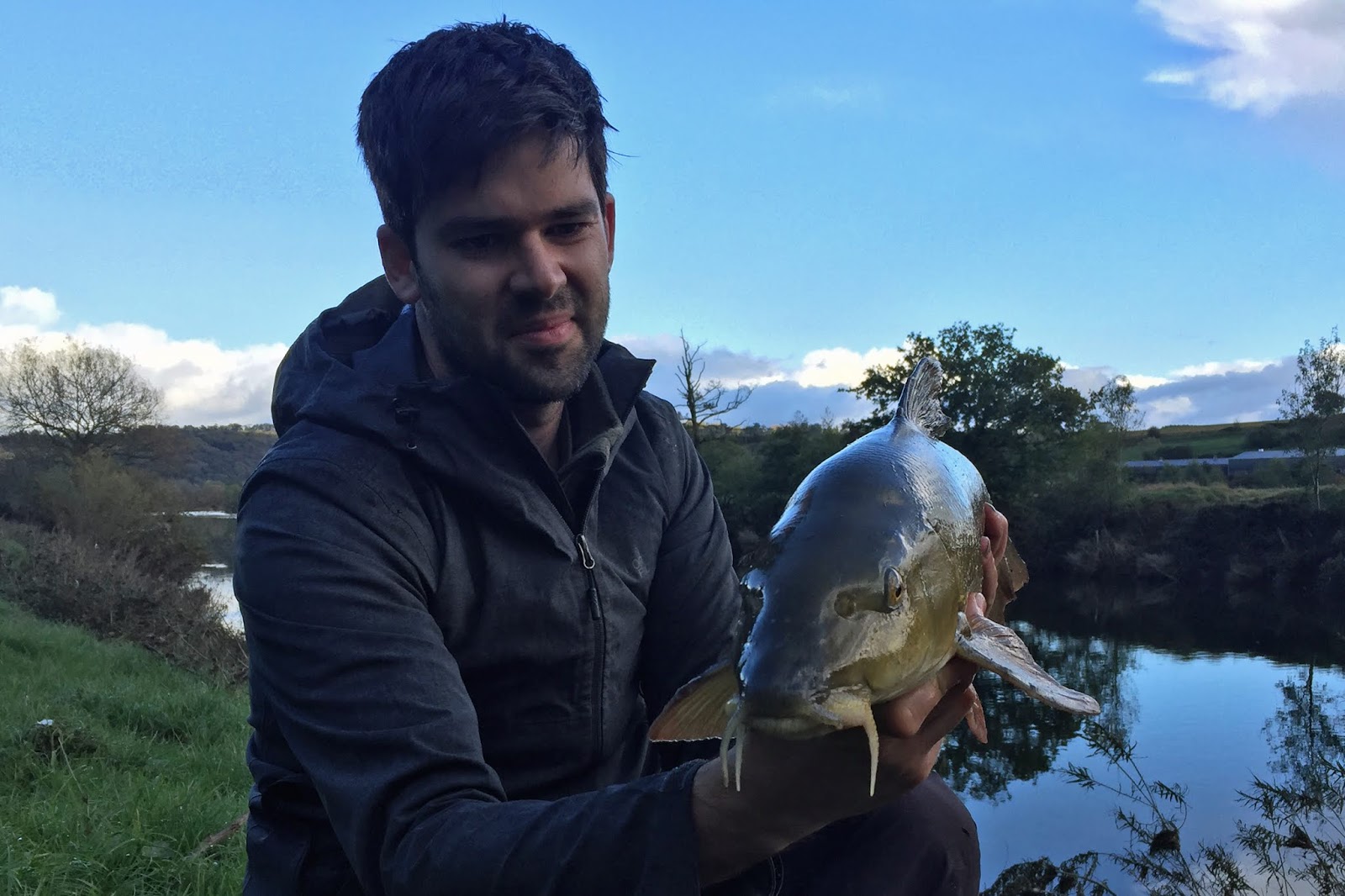
Unable to resist, I loaded a feeder and cast, landing the feeder within a yard of the end of the rainbow.  A second rainbow had since formed outside of the first and I busied myself taking photographs.  Ten minutes later and with the rainbow still painting the spot, my rod arched over and took off over the top of the rest.  Managing to catch the butt just before my trusty Greys Prodigy could wave me a fond farewell, I lifted into the fish which took of rapidly downstream.  Three separate times I tightened the clutch until I daren’t tighten it a click further and not once did it have a moments impact on that first thunderous run.  After perhaps 20 seconds that seemed like an eternity of the fish spooling off line, I managed to turn the fish and it kited from the far bank to mid-river. Gradually I began to make ground, with a little toing and froing for supremacy until the fish was level with me.  With the sun now on the water I was able to see the fish for the first time and watched as it buried its head into a rack of streamer weed.  Instinctively I stepped downstream to avoid the line snagging through the curtain of weed.  The upper hand only lasted a moment as the fish took advantage of my downstream position, turning and bolting down the near side bank.  By now under an overhanging tree, with ample nearside vegetation to dive into on the fishes route back upstream I stepped downstream towards the fish once more, settling in a second small gap in the bracken where I would hope to land her.  As I brought her under the rod tip it was apparent that she was a good fish, both long and thick set.  I looked down in horror… my chosen harbor was occupied by a sunken tree branch.  Twice the fish rolled over it, I felt the line catch and grate across the rigid wood with my heart in my mouth.  And yet it didn’t snag.  The fish didn’t roll behind and under the branch.  Each time she chose to bolt out and away back to the flow until one final time I managed to slip the net under her, my bar of gold from the end of the rainbow.

I secured the net and we both took the opportunity to take a rest, giving the fish the recovery time that her fight both warranted and deserved.  With the rainbow faded away into nothing as if it had given up its secret, and the sky clearing, I lifted the net.  The weight was both apparent at the lifting and even more so as I lay her on the unhooking mat.  She was as broad across the shoulders as any barbel I had ever caught. 

8lb 6 oz was the weight to beat, a modest weight to many but a personal best to me.  The spring loaded... the needle dialed... 9lb 7 oz.  There are no perfect stories, else perhaps that needle might have fallen to not an ounce less than 10lb and my first double, but I was more than happy to take a personal best given up to me by the barbel gods from the end of the rainbow.  

Seek the end of the rainbow - and find a bar of gold...

...all 9lb 7oz of it

Chuffed to bits with a PB - I'll be back in winter when she's carrying another 9oz!

Three more fish followed as the afternoon progressed, each around the 5-6 lb mark.  The third fish tore off even as I was landing the second for my first ever double hook-up.  Unsure of the etiquette of whose fish this should be with Nick stepping across to hook the fish on my rod, we opted to share the fight, Nick starting and finishing it, with me taking a section in the middle.


Barbel-a-plenty
With light now beginning to fade we decided to trade a likely couple of final fish in the deeper water for a chance of a barbel on the float from the lower end of the beat.  In reality we left it a little later than we should have and it was a struggle to track the float in the fading light.  A final fish was not to be, but no matter – it had been a memorable day amongst the seductive and idyllic surroundings of the magical River Wye.

The 'pin  - still awaiting that first float fished barbel...

Are you interested in fishing this beat? If so, tickets for 'White House' can be bought from the Wye and Usk Foundation. Accommodation is available on the neighboring farm, just a two minute walk from the river in the form of five fabulous tipis situated in an apple orchard with beds, linen and BBQ/firepit. Booking and further information can be found here:
https://whitehouseonwye.co.uk/glamping-and-fishing


Friday, 31 August 2018

60 Second Blog Roll - Revisiting the Swale


As part of my work trip to the North East I had intended to follow up my northbound Swale session with a trip to the Wear and then visit the Wharfe on the return journey South.  However, after speaking with a local tackle shop and angling association I was surprised to learn that there isn’t a single day ticket beat on the Wear.  There is apparently a free stretch in Durham at Ferrens Road, but there seems to be conflicting information online regarding whether fishing is prohibited by a local sea trout by-law.  I dropped an email to the local Angling Association with a hope of coercing them to make an exception and allow a visiting southerner a day ticket on their syndicate water, but  without success.  I understand their position entirely, but I do think it's a real shame if the information is correct and syndicates have been allowed to control an entire river without offering day ticket availability.  I could have perhaps pursued a trip on the Tyne or traveled further afield to the Tees, but opted instead to settle into a pub and watch Villa somehow fail to beat Brentford.

My final day in the northeast took longer than expected, leaving me a little short on time to make the extra distance to the Wharfe and scout out a peg or two at Boston Spa.  The Swale at Cundall Lodge was slightly closer and familiarity meant I could find a peg quickly and maximize time with a wet line.
Arriving at 6 pm with the weather blowing a gale and an ominously dark cloud rapidly approaching, I settled into a peg as quickly as possible.  I just managed to get a brolly up and the vitals underneath it before the heavens opened.  I don’t think you’ll see a single barbel fisherman complaining about rain at the moment and it was a welcome sight.  What’s surprising is how little impact these rains are having on levels and I suspect we’ll need something altogether more sustained before we start to see a meaningful rise in levels.

I never felt quite settled in my chosen peg, feeling visible and exposed with little cover on the bank.  So with an hour and a half gone and not so much as a pluck, I took the decision to move peg to the one I had caught barbel from two night before.  Baiting up with pellet I once again cast out my feeders and settled in. In peaceful surroundings it seemed the perfect environment to finish writing up my previous visit for the blog.

In search of inspiration - or any excuse!


It was only fifteen minutes before the first and only take of the session.  A sharp knock, followed by a drop-back on the rod.  Ordinarily I’d have struck the first take, but with laptop in hand I wasn’t quick enough.  After tossing my laptop to the ground I reeled into the slack and struck... delighted to feel that unmistakable sensation of a fish pulling back.

She put up a spirited fight, but never felt like a fish with any real power.  She was all pace and spirit, tearing around the swim, but easily stopped when putting a bend into the butt section.  Slipping the net under a fish of around a couple of pounds, there was no need to find the scales and after a quick couple of net photo’s whilst she rested the fish was returned.  It was interesting to see just how much colour the peat adds to the water on the Swale, with a considerable difference in shade between the fish at the surface and resting in a foot of depth. 

Resting quarry, just under the surface and tinged with peat at 1ft under the surface.

There were to be no further takes before the sun went down and I had promised myself an early finish before a long drive in the morning.  However, the omen of a perfectly barbel-shaped cloud approaching the moon was too good to refuse and I cast out for one last half-hour into the darkness.

Not packing up under a Barbel-shaped cloud

Best not to anger the river gods


Alas, shortly afterwards it became apparent that the cloud was more likely an apparition of a barbel making it’s way to the great streamer-weed in the sky.  With considerably more splashing than would be accounted for by a leaping fish, accompanied by the unmistakable shriek of an excited otter, the silence was broken.  The subsequent wet-munching sound left me in no doubt that the otter was having more success than me, and I decided to call it a day.  One small barbel was hardly prolific, but I’ve always considered any trip with barbel landed to be a success and it maintained my 100% record on the Swale!

Splash-Splash-Shriek-Shriek-Chomp-Chomp

The disconcerting sound of an otter enjoying a la carte opposite .

Saturday, 25 August 2018

A Trip of Firsts – The River Swale


For a while now I've been meaning to productively use time away with work to address work life balance and push my boundaries by fishing new rivers.  With conditions finally improving and water temperatures down to around the 18 degree mark I felt it was safe to make a return to the banks.  A mid-week site visit in the northeast provided an opportunity to visit the River Swale, conveniently located just an hour south of my destination.  With the very best of support from the Facebook Barbel forums I was put onto Cundall Lodge, a convenient day-ticket fishery not far from the A1(M).  The trip would not only be my first outing of the season and first ever experience of the Swale, but also an opportunity of a first barbel on the new Torrix (bought late last year) and Youngs ‘pin (bought late last week!).  All in all, my mouth was watering at the thought of the trip and hopefully the barbel would be in the mood to follow suit. 

Shiny kit syndrome
My 2nd hand Youngs Purist II CL
Cundall Lodge Farm 
A short jaunt off the A1M

An early and hectic morning gave me enough time to clear the decks, and I was away for midday, arriving at the fishery for just gone 3pm.  The day ticket deposit box was easily located before making my way down through the field tracks to the river.

A quick drive of the beat led me onto a deeper section with a little flow.  I’d received a decent brief from one of the regulars (thank you James!), which helped enormously on a tight timeframe, but all in all it appears that barbel turn up along the entire stretch.  It's worth noting that the driving tracks are precariously close in places to the steep sided banks and the riverwards tilt of the flood bank does nothing to improve the experience! As such, I'd be inclined to avoid the top half of the stretch in particularly wet weather.

The River Swale – steep banked, peaty and quintessentially pretty
I began with 60g feeders, filled with halibut’n’hemp groundbait, hemp, corn and pellet in order to get some bait down.  I figured with the whole beat looking so inviting, the barbel were likely nomadic and would need drawing into the swim.

Frustratingly, I was to miss the first take, a violent chub-like shaking of the rod tip. Having forgotten that I’d set the baitrunner, I struck into a tensionless scream of spool.  With the coming hour passing without an opportunity to redeem myself, I was already hoping my chance hadn’t passed.  Without a fish in the first hour and a half I was also wondering whether the clatter of a large feeder on such a small river was counterproductive.

At just before 6pm and shortly after a change to tiny 20g Drennan feeders, I received one of those takes that you just can’t miss.  No tap-tap, not even a 2ft twitch, just the rod bending double into a full-throttled run.  It’s fair to say that my first take on the ‘pin scared me half to death.  With barely 10ft of line between rod and fish, the ratchet roared as the caged spool span in earnest.  A first barbel on the ‘pin… a first on the Torrix… a first on the Swale. Hopefully...

My first impression was that this fish was heavy, whether as a result of rod action, controlling the fish with thumb on spool or the depth of the fish’s watery lair, there was no ground to be made.  On three separate occasions the fish tore off upstream – something I’ve always held as a sign of a better stamp of fish.  My mind was racing. Perhaps it was a carp.  Maybe, just maybe it was a double.  I knew the Swale contained hidden snags and with 14lb line I was keeping up the pressure.  My arm was beginning to ache.  For as long a time as I can remember, I felt nervous.  When the fish broke surface it was a tough call on weight.  The fish was certainly thick-set, not a bit like the long lean summer fish on the Wye.  Soon enough, the net was slipped under the subdued fish, a fish of firsts.

If the shorter-than-usual blank and terrible 'pin casting were a hindrance in my inexperienced hands, the Torrix and ‘pin were a fabulous combination in the fight, seemingly coming to life the moment the battle ensued.  With the Torrix’s soft through action and power where it counted married with the direct undiluted contact of pin with fish, there are few tussels with barbel I have enjoyed more.

It took all of my restraint to leave that net in the water and give the fish a good rest before it would be weighed, which I still hadn’t manage to gauge in the peat-tinted water.

Resting a barbel – allow them to recover before removing and before releasing
Alas, a hat-trick of firsts was not to become four and I would have to wait until another day to taste my first double figure barbel.  She weighed a respectable 8’0 and a default personal best for the Swale.  With the very briefest of photo’s, she was rested once more until fighting fit before being released into the deep weedy channel beyond the flag iris.

8’0 – and sporting a fight worthy of any double figure fish

A little overwhelmed I took a moment to walk the bank and have a breather.  Beautiful scenery, a near-bank kingfisher and all manner of insect life enjoying the bankside vegetation, the Swale is one of those effortlessly beautiful rivers.  A river to savour, to be enjoyed irrespective of catching.

Wildlife Spot of the Day – a Ladybiird Pupa
Truly made up with my first barbel from the Swale, it was with great sadness that my next siting of one of it's whiskered residents was to see one floating past me downstream . At first I thought this fish had been caught just upstream, but on closer inspection of the photographs the fish looks bloated, suggesting it had been dead at least a little while.  The water temperature had lowered considerably in recent weeks, which had informed my decision to return to the banks.  I now found myself questioning my rationale.  Yet the fish I had caught and returned had not struggled in the slightest. It was still lively as I landed it and had all but tried to drag the (tethered) landing net in before it was returned.  I’m sorry to say that in my judgement this particular barbel is likely to have befallen poor handling practices and it should re-emphasize the importance of properly resting barbel before returning them.

Distressing viewing – one dead barbel is one too many

Returning to fishing, I took the opportunity to re-position my downstream rod, casting further downstream to the shadow of an overhanging tree.  Another hour or so passed before I was stumbled upon by another member of the Facebook barbel forums.  He too had never fished the Swale and was looking to target the river whilst travelling for work.  Not wanting to disturb any barbel that were on the prowl by shouting up the steep bank, I made my way to the top and began chatting about the beat and the little experience I had of it.  I had removed the Torrix and ‘pin but left the downstream rod in place on a baitrunner and my back was turned to the river when it howled off.  The fish must have taken some 20 yards by the time I’d scuttled down the bank and got it back under control.  Thank heavens for baitrunners. The fish was a touch smaller at 7’10 but nonetheless gave a good account of itself.  Notably it was a rich bronze colour, with deep brown gill plates – presumably an effect of living in a peaty river.  I can’t be sure, but I think this might just have been the prettiest barbel to ever have graced my net.  With the same resting protocol followed, I opted for only the briefest of snapshots with my phone as I unhooked, weighed and returned the fish to the water within twenty seconds.  After a further rest, she was again lively and both the fish and I had confidence in a return to the flow.

7'10 - and one of the most beautiful barbel I've ever caught
With a couple of hours left of the session I tried a few more subtle rig and bait changes, with the only success being a chub just shy of 4lb.  A long fish with a head like a staffy and a cavernous mouth even by chub proportions, a brute of the future perhaps.  In typical chub-like fashion, the fish gave me much trouble diving for the weed in 8ft of bankside depth, but with a little fortune and some encouragement eventually pulled free from the snags and was promptly photographed and returned.


3’12 – a brute of the future

Leaving an hour after dark, I was glad to be staying in a nearby bed and breakfast, The Oak Tree in at Helperby.  On arrival, they had kindly arranged a delicious deli-board, chunky hand-cut chips and a pint of black-sheep, long after the kitchen had closed.  Between that and the jacuzzi bath, I couldn't have wished for a better base to return to and welcome respite from a long albeit enjoyable day.


I’ll leave you with some of the photo’s I took into the evening, including a nod to the fantastic ale (or bitter in this case) that comes from the Black Sheep Brewery.

Hoping for one last twitch

The magic hour – for fishing and photography alike

Dusk – a great time for barbel

Cundall Lodge Farm –sweeping bends and overhanging willows

Yorkshire’s Ale – almost as good as it’s fishing


Tuesday, 7 August 2018

60 Sec.Blog Roll - Fending off Barbel Withdrawal


This is the first of a series of ’60 second blogs’, designed for a quick read (and equally hastily put together!) These will focus on a short trip report, baits or tactics and hopefully feature a little something for everyone.

With Sunday afternoon originally set-aside for barbel fishing, but conditions still not suited to fish-welfare, I decided to spend the time sorting through my fishing gear after moving house. With a few hours of the afternoon left spare and an urge to feel a bend in the new Torrix, I took a trip out to my local carp lake, Astwood Fisheries.

The fishery is equipped with an aerator, and my target species would be carp. Now I know that plenty of river anglers are entirely averse to carp fishing. Personally, I enjoy all forms of the sport and all manner of quarry. Moreover, carp are extremely tolerant of low oxygen conditions and the fishery is served by aerators. I also know the owners reasonably well so was confident when they reported there had been no evidence of fish showing distress.

Arriving at the fishery, I discovered Bluebell Pool had been recently vacated following an earlier match. The fish seemed to be in obliging mood, already occupying the margins of vacated swims. My target would be one of the lower twenties which occupy this pool, having caught fish to just shy of 19lb in the past.

I opted for a swim with an overhanging tree, offering the fish some shade, and my preferred margin depth of around 18 inches. The peg shelves off to about 11ft, where there were vast swathes of fizzing bubbles. Without any tench stocked, my assumption was this was spawning silvers, but it would give me something to explore if the carp weren’t going to feed in close.

My target swim, with a shaded margin hopefully giving an edge

I set up the Torrix with 12lb mono, through to an 8lb hook length attached to a Size 10 Korum Expert hook. The set-up was a little heavier than I would normally fish in a commercial, but there was a reasonable chance of larger fish and I didn’t want a protracted fight in the conditions. The peg was also located near a troublesome aerator rope and I wanted to be able to put the Torrix through its paces by ‘leaning into’ a fish if needed. I wasn’t expecting subtle bites, so opted for one of my late father-in-law’s cane and cork perch bobbers to give a clear visible indicator for the sail-away bites.
Baiting up with corn and pellet, I gave the fish fifteen minutes to settle on the feed with some confidence before wetting a line with a 1cm cube of spam. Barely a few seconds passed before the first fish tore off from the margins. Forgetting to slacken off my clutch from previous use with heavier gear, the Torrix gave a splendid account of its forgiving action, bending right the way through the narrow blank and cushioning the impact whilst I fumbled to loosen the front drag.

Lovely action - the Torrix 1.75 bends right through the narrow blank

It quickly became apparent that the fish had been foul hooked and this time it was the Torrix’s brute power to be put to the test, needing to drag the swimming fish both backwards and upwards into the net. Tiring the fish would have taken far longer than I was comfortable with, so being heavy handed appeared to be in all parties’ interests. Despite its forgiving action the Torrix barely blinked, comfortably providing the power required to bring the fish to net. A hard-fighting tail-hooked common around the 6lb mark was quickly photographed, rested and returned.

A foul-hooked common – a good test of the Torrix’s qualities

Having fed the swim whilst playing the earlier fish, the swim was still alive with swirls and three more takes quickly followed. However, each of these three fish threw the barbless hook with relative ease. Unwilling to accept this as co-incidence, I changed to a trusty Guru QM1, by far and away my favorite barbless pattern and one I’ve noted to be extremely effective at avoiding hook pulls.
As the afternoon went on and with the hook now holding firm, I continued to catch consistently, with 10 fish to around 12lb gracing the net in a little over an hour and a half.  Great sport and a shot in the arm for the barbel withdrawal symptoms! So if you’re like me and have been sat pining at the door waiting for the rains, get out there and give your local carp water a try!

Wildlife Spot of the Day - A speckled wood butterfly


Thursday, 2 August 2018

Dissolved Oxygen and whether to Fish


Given the unseasonal British weather I’m yet to venture out onto the bank this season.  Between that and refurbishing a new house, opportunities to kick-off the blog have been few and far between.  I thought I’d fill the void by sharing my thoughts on the discussion around dissolved oxygen and the debate centered around targeting barbel in such conditions.  As with all things fish-welfare there is a range of strongly held opinions, many of them conflicting and a lot of misinformation.  I always encourage people to heed information from reputable sources.  With a degree in Marine and Freshwater Biology, I would like to think my own opinions carry at least a little validity, but I should stress they are just that – my personal opinions.   

For anyone somehow still unaware, the months of hot weather and lack of rainfall have caused a sharp reduction in water volume in all of our rivers and a spike in water temperature upwards of 25 degrees Celsius.

The Wye at Kerne Bridge – Dry as a bone (Photos courtesy of Worcester Angling Society)


The availability of respirable oxygen for fish in rivers is a complex relationship between saturation, mixing, temperature, pressure, photosynthesis and salinity.  For those wanting a more detailed explanation, may I recommend https://www.fondriest.com/environmental-measurements/parameters/water-quality/dissolved-oxygen/.  My belief, in current conditions ,is that the discussion should focus largely on temperature.  The remaining factors show a degree of consistency or fluctuate routinely, sufficient for fish to be appropriately adapted to these changes.  Water temperature by comparison is seeing exceptional increases as a result of, at 35, the most prolonged heatwave in my living memory. 

That said, UK temperature variation itself has very little direct effect on fish mortality.  It is the indirect effects that cause issues, with the main culprit being reduced carrying capacity for dissolved oxygen which comes with increasing water temperature; or in extreme cases of course a complete absence of water when rivers dry up. 
The relationship between Dissolved Oxygen and temperature (Photos courtesy of the RACG)

For fish mortality, oxygen is everything.  When you see large fish-kills due to pollution incidents, it is not always the pollutant itself which is directly responsible, rather the effect it has of stripping oxygen out of the water – either as a result of high chemical oxygen (COD) or biological oxygen demand (BOD).  Substances such as milk for example aren’t harmful in themselves, but are devastatingly effective at stripping oxygen from a watercourse.  The availability of dissolved oxygen in watercourses is influenced by a variety of factors, not just water temperature and one of the main factors to consider is the effect of daily fluctuations in oxygen levels as a result of photosynthesis in aquatic plants.  These plants include visible vegetation such as streamer weed, algae and also microscopic phytoplankton which is abundant in river water at this time of year.  The saturation of water with oxygen is achieved through diffusion, mixing and through photosynthesis, the latter making a considerable contribution.  There is a clear correlation between dips in dissolved oxygen levels at night-time when photosynthesis ceases.

The relationship between Dissolved Oxygen and daylight hours as a result of photosynthesis (Photos courtesy of the RACG)

So, we know that the capacity of a river to carry dissolved oxygen decreases with increases in temperature and that it dips further at night when photosynthesis ceases. 
Another factor to consider is that, importantly, every species of fish is different and adapted to suit a specific survival strategy.  This survival strategy may relate to the fishes environment, behavior or otherwise. 

Pike for example have evolved as ambush predators, with a physiology designed to use energy and oxygen reserves within blood and tissues in short rapid bursts when lunging at prey and use very little energy in between.  This is also part of the reason why pike can be found skulking in slack water, they’re just not a long-distance runner.  As a result, pike are particularly vulnerable in low oxygen conditions and many avoid targeting them in the summer months altogether. 
Salmonids are different again, being more sensitive to low DO even in resting conditions.  They have evolved to strictly manage energy budgets to prioritize returning to spawning grounds.  Adaptation is generally about compromise and oxygen sensitivity has found itself demoted in this instance.  It’s especially important to never remove a salmonid from the water once landed, unless you’re planning on dispatching it. 

Carp meanwhile have evolved to live in weed-choked, water-scarce puddles and can cope more than adequately in low oxygen environments.  That said the impact of reduced oxygen environments can be significantly worsened by overstocking, hence a number of commercial fisheries need aerators to preserve fish stocks.  Catfish are perhaps an even better example.  In south-east Asia it’s possible to walk around fish markets amongst live catfish displayed on market tables, hours after being caught. 
So where do barbel sit in all of this? Similar to salmonids, they exist comfortably in the tooth of the flow and have no difficulty exerting energy over long periods of time or coping with sudden bursts of speed.  Adaptations are focused on sensory detection of food sources and being streamlined to exist and feed in fast flowing water.  They are less sensitive to oxygen availability than salmonids and typically recover better.  However, the very reason anglers love to pursue them is what makes them especially vulnerable.  No matter how you approach landing a barbel, they are a powerful fish and will always need to be played to a degree of tiredness.  Even under the rod tip when you think they’re subdued, they always somehow seem to find another burst of energy such is their fervor for escape. 
From the discussions I’ve seen and been involved in, I don’t think many dispute that barbel are vulnerable in these conditions.  What does appear to divide opinion is whether a rested and returned barbel will recover fully or go on to deteriorate further.  Many are skeptical of this.  All I will say is that I’ve seen countless trout removed from the water for a photo or unhooking only to be returned, and that I have watched these same fish struggle in the margins for hours before being found floating dead the following morning.  This paired with reports (and photographs) from fellow anglers and kayakers of barbel being spotted floating down the river is enough, for me, to be convinced.

Belly up - a dead barbel after a sewage spill   

I’ve been especially surprised to see matches continuing on rivers in these conditions, with recent reports from a well-known angling writer of 40+ angler festivals and a match where 150lb of fish were caught, and presumably retained in a keepnet.  Fisheries have been too slow to react in my opinion, dragging their feet on closing their banks and reluctant to postpone money-spinning matches.  I appreciate a lot of work goes into the organization of these, but if organizers can deal with postponing for flood events, they should too be able to postpone for fish welfare reasons.  One of the main arguments for changes to the closed season is that it would be better controlled by the fisheries.  However, I feel we’ve seen little evidence from a number of these that welfare features sufficiently on their agenda to place our trust in their governance.  It’s intriguing to note that the Wye and Usk Foundation (WUF) continues to offer day tickets on the Wye when many fisheries have now finally closed their banks.  The WUFs objectives include to conserve, protect, rehabilitate and improve the salmon and other indigenous species of animal and plant life… and to advance the education of the public in the conservation of rivers, river corridors and their animal and plant life and the need for conservation, protection, rehabilitation and improvement of such environments.  A charitable foundation set-up with the above mandate should be leading the way in prioritizing fish welfare and be actively involved in providing appropriate guidance to the angling community.

Probably the biggest impact which must be considered before wholesale decisions would be taken to close rivers would be the impact on local businesses reliant on angling tourism.  However, a commitment to book an angling holiday, months and even a year in advance has always carried a degree of weather related risk and I believe it is up to the angler to have accept this and have a Plan B for when they arrive, be it commercial fisheries or otherwise.

Clearly there is a divergence in opinion across the angling landscape.  Some feel that the risk is too great and that it is especially unclear whether fish recover from the ordeal of capture in the immediate or longer-term future.  For some, an element of doubt is enough and a prudent approach is adopted.  For others, photos of dead barbel or a capture of their first ‘belly-up’ barbel is enough to keep them from wetting a line.  Others are firmly of the opinion that if there was that much risk then fishing would have been prohibited by fisheries or the relevant agencies and trusts.  There is a lamentable absence of clear guidance on how warm is too warm and how low is too low with regard to available dissolved oxygen.  With one eye on climate change resilience, my hope is that lessons will be learnt from what may or may not prove to be an exceptional summer and research undertaken to provide a guideline value, be it temperature or oxygen level based, either for the closure of fisheries or too at least allow anglers to make an informed decision.

Equivalent guidance exists for salmonids with fishery closures triggered around 19o and a number of fisheries already prohibit the targeting of pike during summer months.  Perhaps equivalents should be applied to targeting barbel or other sensitive coarse species in certain conditions.
If you must fish, please follow sensible precautions.  Upscale your tackle (if necessary) to allow you to land fish as quickly as possible.  Use a large specimen carp net that gives maximum room to rest the fish.  Rest fish in the net before unhooking, and unhook the fish in the water.  Photograph fish in the water whilst it is resting, using the opportunity to hone and perhaps take some artistic photos of your quarry whilst they rest.  Ask yourself if you really need to weigh the fish, if it isn’t a candidate for a personal best I would suggest the answer is no.  If you must weigh it, have everything ready by the water’s edge, use a wet sling and complete the elements where the fish is removed from the water with absolute haste and once the fish is rested.  After each stage of handling (landing, unhooking, weighing) rest the fish.  Ensure the fish is fighting fit, and then give it another 10 minutes for good measure.   If the fish has gone belly up at any point, consider resting it for longer.  Target your fish in environments where dissolved oxygen is at its highest – downstream of weirs or agitated water; and be mindful that dissolved oxygen drops sharply at night.  If you see evidence of fish populations in distress, call the Environment Agency – the earlier they have time to act the more chance they have of making an effective response.

 The EA – (left) aerating a watercourse to increase oxygen levels; and (right) rescuing fish from the Teme.   (Photos courtesy of the EA)

For the time-being then it is a matter of personal opinion and perhaps one of conscience.  As discussed, I would like to think that conditions this summer will prompt further research and a greater degree of preparedness.  Misinformation thrives on a lack of clear guidance and I would like the Environment Agency to step up as they continue to plan for climate resilience going forwards.  For me, I’ll not wet a line again this season until I see peak daily water temperatures down to at least 20 degrees on the rivers I target. (Note - for the 2019 season with higher flow volumes pushing through giving greater saturation and high water temperatures not yet being prolonged, I'll be using 25 degrees Celsius as my go/no-go limit for fishing the rivers.)